

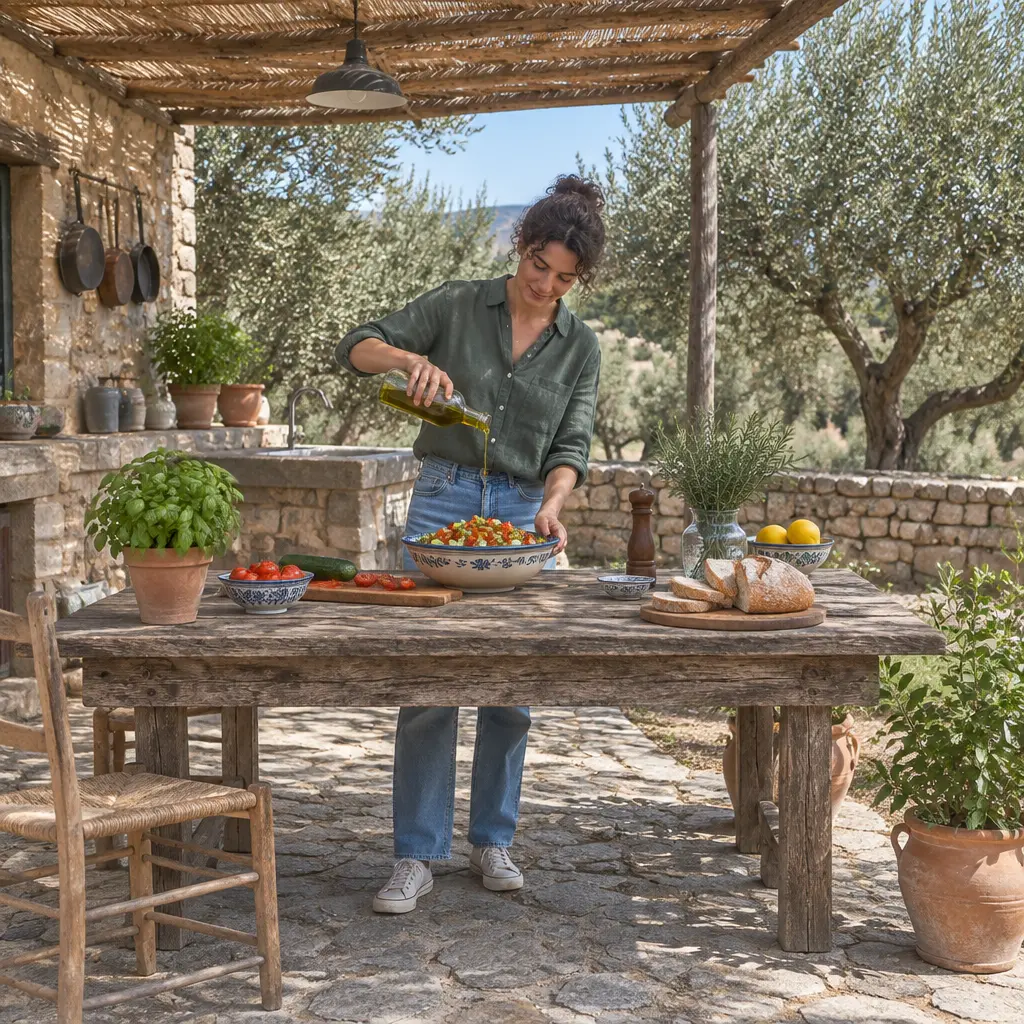
Extra virgin olive oil (EVOO) is olive oil obtained directly from olives by mechanical or other physical means and meeting defined chemical and sensory quality standards. It is a culinary foundation of Mediterranean cuisines because it brings flavor, supports familiar cooking techniques, and links everyday meals to regional food traditions. The scale is substantial: the International Olive Council estimated world olive-oil production at about 3.38 million tonnes in the 2022/23 crop year. This article explains what qualifies as extra virgin, how its flavor and production vary, how it is used in Mediterranean cooking, and what nutrition research and practical storage guidance can—and cannot—tell us.
Extra virgin olive oil quality begins with standards and production
“Extra virgin olive oil” is a legally defined grade, not simply a marketing phrase for premium oil. The International Olive Council’s trade standard describes virgin olive oils as oils obtained from the fruit of the olive tree solely by mechanical or other physical means under conditions that do not alter the oil. Extra virgin is the highest virgin-oil category: it must meet limits for chemical indicators and pass sensory assessment without defects. The European Union also sets category requirements, including a maximum free acidity of 0.8 grams per 100 grams for extra virgin olive oil. Acidity is a quality measure, not a direct measure of how sour the oil tastes.
Those requirements connect the name on the bottle to the condition of the olives, the extraction process, and careful handling afterward. The main related categories are extra virgin, virgin, refined olive oil, and olive-pomace oil; they differ in how they are produced and classified, so they are not interchangeable descriptions.
Mechanical extraction and the meaning of “cold”
Mechanical extraction separates oil from crushed olives without refining it with chemical solvents. Modern mills commonly clean and crush the fruit, mix the resulting paste, and use centrifuges to separate oil from water and solids. The European Union’s “first cold pressing” and “cold extraction” terms are subject to temperature-related conditions; when such claims appear, they refer to extraction at temperatures below 27°C. They do not, by themselves, prove that an oil is fresher, more flavorful, or superior to every oil without the claim.
Chemical and sensory quality checks
Free acidity, peroxide value, and ultraviolet absorption are among the chemical measures used in olive-oil classification. Sensory assessment adds a different kind of evidence: trained tasters evaluate positive fruitiness and check for defects such as rancid, musty, or winey-vinegary notes. The International Olive Council’s method treats fruitiness, bitterness, and pungency as positive attributes of virgin olive oil, while defects can disqualify an oil from the extra virgin grade even when its label or appearance seems convincing.
Olive varieties, harvest, and regional expression
A cultivar is a cultivated variety of olive, and cultivar, growing conditions, harvest timing, and milling all influence an oil’s aroma and taste. Arbequina oils are often described as mild and fruity, while oils made from varieties such as Coratina or Picual can be more robust and bitter or peppery; these are tendencies, not guarantees. Earlier-harvest fruit often produces greener, more assertive oils, while later harvesting can yield a softer profile and more oil. Regional traditions—including Spanish, Italian, Greek, and North African styles—reflect these choices alongside local foods and cooking practices.
Extra virgin olive oil supplies flavor and function in Mediterranean cuisine
In Mediterranean cooking, EVOO is both an ingredient and a finishing condiment. It carries aromas, adds richness, and helps distribute flavors across vegetables, legumes, grains, fish, and bread. Its culinary role is not limited to uncooked dishes: cooks use it for sautéing, roasting, braising, and other everyday preparations, choosing oils with different flavor strengths to suit the food.
Finishing oils, dressings, and dips
A finishing oil is added near the end of preparation or at the table, where its aroma remains prominent. A peppery oil can sharpen bean soup or grilled vegetables; a milder, fruitier oil can complement delicate fish or a simple salad dressing. In dishes such as Greek horiatiki salad, Spanish pan con tomate, or Italian bean soup, EVOO contributes texture and flavor as well as fat-soluble aroma compounds. These examples illustrate shared culinary principles, not a single uniform “Mediterranean” recipe tradition.
Cooking with olive oil
EVOO can be used for ordinary home cooking, including sautéing and roasting. The smoke point varies with oil composition, freshness, and refinement, so a single number cannot describe every bottle. Heating also changes aroma and can reduce some delicate flavor compounds, but the suitability of an oil depends on the method, temperature, and duration. For high-heat cooking, avoid letting oil smoke; for a pronounced fresh flavor, add some oil after cooking as well.
A practical pairing guide
- Use mild, fruity oils with delicate vegetables, fish, and baking.
- Choose medium-intensity oils for tomato dishes, roasted vegetables, and everyday sautéing.
- Try robust, bitter, or peppery oils with beans, hearty greens, soups, and grilled bread.
- Taste before serving: bitterness and a peppery throat sensation can be positive signs of an assertive oil, but they are matters of preference.
This flexibility helps explain why EVOO is a backbone ingredient rather than a garnish reserved for special occasions. Its flavor can be adjusted to the dish, and the same oil may contribute to cooking, dressing, and finishing.
Extra virgin olive oil contributes mainly unsaturated fat
Nutrition guidance describes olive oil as a source of dietary fat, much of it monounsaturated fat, including oleic acid. The U.S. Department of Agriculture’s FoodData Central lists olive oil at about 884 calories per 100 grams, as do most pure fats and oils; energy density means portion size matters even when an oil is part of a healthful eating pattern. EVOO also contains smaller amounts of other compounds, including polyphenols, whose levels vary with cultivar, harvest, processing, and storage.
Evidence from Mediterranean dietary patterns
The Mediterranean diet is a broader eating pattern, not a single ingredient or a guarantee of health outcomes. It typically emphasizes vegetables, fruits, legumes, whole grains, nuts, and olive oil, with fish and other foods included in varying amounts. In the 2018 reanalysis of the PREDIMED randomized trial, researchers reported that Mediterranean diets supplemented with extra virgin olive oil or nuts were associated with a lower rate of major cardiovascular events than the comparison diet among adults at high cardiovascular risk. The result supports the dietary pattern studied; it does not establish that olive oil alone prevents disease or that every person will experience the same benefit.
Understanding polyphenols and health claims
Polyphenols are plant compounds that can contribute bitterness and pungency, but their concentration differs considerably among oils. The European Food Safety Authority has authorized a specific health claim concerning olive-oil polyphenols and protection of blood lipids from oxidative stress, conditional on a daily intake of 5 milligrams of hydroxytyrosol and its derivatives from olive oil. This narrow, regulated claim should not be expanded into promises that EVOO treats or prevents illnesses. A balanced diet and overall energy intake remain important.
Extra virgin olive oil freshness depends on storage and informed buying
Olive oil is vulnerable to oxidation and quality loss from oxygen, heat, and light. The North American Olive Oil Association advises keeping oil sealed and stored away from heat and light; dark glass, tins, or other protective packaging can help limit exposure. Refrigeration is not usually necessary for everyday storage and may cause temporary cloudiness or solidification, which reverses as the oil warms.
Read the date and protect the bottle
When shopping, look for a harvest date when available, choose a container size that can be used while the oil is fresh, and prefer packaging that limits light exposure. “Best by” dates are not the same as harvest dates, and neither guarantees that an oil was handled well. At home, close the cap promptly and keep the bottle in a cool, dark cupboard rather than beside a stove or in direct sunlight.
Taste for freshness and avoid label assumptions
Fresh EVOO commonly has some recognizable olive fruitiness, though intensity varies. A stale, waxy, crayon-like, or rancid smell can indicate deterioration; a bitter or peppery sensation alone is not a defect. Terms such as “natural,” “premium,” or “cold extracted” should be interpreted alongside the legally defined grade, producer information, dates, and sensory quality. Price and country of origin alone cannot verify freshness or authenticity.
Extra virgin olive oil connects food culture, farming, and global trade
Olive oil production is rooted in long-established agricultural landscapes, especially around the Mediterranean, while consumption and trade are global. International Olive Council statistics show that output can vary sharply between crop years because olive trees respond to weather, water availability, and their natural alternate-bearing cycle. Its estimate of approximately 3.38 million tonnes for 2022/23 provides a useful snapshot of the market’s scale, not a fixed annual norm.
That variability has practical consequences: drought, heat, harvest conditions, and changing production costs can affect supply and retail prices. For consumers, learning to compare flavor, freshness information, and intended use can make choices more meaningful than relying on prestige labels. For cooks, using EVOO thoughtfully—from a measured cooking portion to a fresh finishing drizzle—keeps the ingredient connected to the dishes and foodways that give it significance.
Conclusion: Extra virgin olive oil remains a culinary cornerstone
Extra virgin olive oil combines a defined quality standard with distinctive flavor, practical versatility, and a central place in many Mediterranean food traditions. Its grade depends on mechanical extraction, chemical measures, and sensory evaluation; its cooking role spans dressings, finishing, and heat-based preparation; and its nutritional relevance is best understood within an overall dietary pattern rather than through exaggerated claims about one food. Production statistics also show why harvests and prices can change from year to year.
To put these ideas into practice, taste oils from different varieties, store them away from light and heat, and match their intensity to the dish. For further reading, consult the International Olive Council’s standards and market data, the European Union’s olive-oil rules, and the research literature on Mediterranean dietary patterns.
Sources: International Olive Council, Trade Standard Applying to Olive Oils and Olive-Pomace Oils, https://www.internationaloliveoil.org/wp-content/uploads/2022/12/COI-T.15-NC3-REV-19_EN.pdf; International Olive Council, World Olive Oil Figures, https://www.internationaloliveoil.org/what-we-do/economic-affairs-promotion-unit/; European Commission, Olive Oil, https://agriculture.ec.europa.eu/farming/crop-productions-and-plant-based-products/olive-oil_en; European Commission, Commission Regulation (EEC) No 2568/91 on the Characteristics of Olive Oil and Olive-Pomace Oil and on the Relevant Methods of Analysis, https://eur-lex.europa.eu/legal-content/EN/TXT/?uri=CELEX:01991R2568-20220406; U.S. Department of Agriculture, FoodData Central: Oil, olive, https://fdc.nal.usda.gov/; Estruch et al., Primary Prevention of Cardiovascular Disease with a Mediterranean Diet Supplemented with Extra-Virgin Olive Oil or Nuts, New England Journal of Medicine, 2018, https://www.nejm.org/doi/full/10.1056/NEJMoa1800389; European Food Safety Authority, Scientific Opinion on the Substantiation of a Health Claim Related to Olive Oil Polyphenols and Protection of LDL Particles from Oxidative Damage, https://www.efsa.europa.eu/en/efsajournal/pub/2033; North American Olive Oil Association, Olive Oil Storage, https://www.aboutoliveoil.org/olive-oil-storage.